Women Watch Payment Terms: 30/70, LC and Trade Assurance
For a women watch order, the payment method is not a formality settled at the end of the negotiation. It decides who carries the risk while the movements are being bought and the cases are being plated, which is a two-stage build that most gift categories do not have. A 30/70 transfer, an LC and Trade Assurance protect different parts of that build, and only one of the three can be made to cover the assembly step where most watch problems appear.
Why a Watch Order Pays Differently From a Bag Order
A bag is built in one flow: cut, sew, finish, pack. A watch is built in two. The case, bezel and strap are produced and plated first, then the movement, dial and hands are fitted and the case is closed and pressure tested. Those two stages are separated by weeks, and the first stage consumes most of the money because the cases are plated in batches and the movements are bought up front against a forecast.
That structure changes what a deposit is for. In a bag order the deposit covers material and labour that the factory can slow down if the buyer disappears. In a watch order the deposit covers movements already purchased and cases already plated, which the factory cannot easily resell in the buyer colour. Suppliers therefore ask for more money earlier on watches than on bags, and buyers who plan cash flow on bag terms are the ones caught short at the assembly stage.
30/70: The Default, and What the Deposit Actually Buys
The 30/70 transfer is the default in this category because it is simple and cheap: no bank charges beyond the wire fee, no document set, no platform in the middle. The 30 percent is paid against the proforma invoice and releases production; the 70 percent is paid against a pre-shipment inspection report, before the documents are released.
The weakness is what the 30 percent does not buy. It buys the right to have the order made, not the right to inspect the assembly. If the case plating is wrong or the water resistance test fails, the leverage is the 70 percent balance, and that balance is claimed by the factory as soon as the goods are packed. Once the balance is paid against a packing list rather than a bench test, the buyer is negotiating a remedy after the money has left.
Two clauses make 30/70 workable on watches. First, tie the balance to a signed inspection that includes a pressure test on a sample from the run, not just a carton count. Second, state that the movement grade is fixed before the deposit is paid, because a supplier who has already bought movements will not change them later without a price adjustment.
Letter of Credit: What the Document Set Adds on a Watch
An LC at sight moves the risk to the banks, at the cost of fees on both sides and a document set that has to be exact. On a watch order the set is longer than buyers expect. Beyond the commercial invoice, packing list and bill of lading, a lithium button cell shipment needs the battery declaration, and the plating report matters because nickel release is a compliance item in several markets, not a quality preference.
That is the trap with LC on watches: the bank checks documents, not the goods. A compliant document set releases payment even if the assembly is wrong, and a single discrepancy lets the bank refuse the documents while the goods sit at the port. An LC 60 days shifts the timing but not the principle: it buys time after shipment, not protection before it.
Use an LC when the order is large enough that the bank fees are minor against the value and the supplier is new to the buyer. Do not treat it as a quality control. The quality control has to be written into the LC as a required inspection certificate from a named third party, or it does not exist.
Trade Assurance: The Escrow That Covers Assembly, Not Just Shipment
Trade Assurance holds the money with the platform and releases it against agreed milestones. Its advantage on a watch order is that the release condition can be an inspection result rather than a shipping document, and the dispute route exists before the goods move rather than after.
Its limit is that the protection is only as specific as the order page. A generic description of the watch leaves the platform adjudicating on colour and quantity, not on whether the case passed a pressure test. Write the assembly criteria into the order: movement grade, case plating finish, pressure test result and the number of pieces inspected. Then the escrow has something to enforce.
Choosing Between the Three
Three questions decide it, in this order. How new is the supplier: a first order with an unknown factory justifies the LC fee or the platform fee, a repeat order rarely does. How much of the order value is in the movements: the higher that share, the more the deposit needs a paper trail. And how much assembly risk is there: a simple two-hand quartz watch with a glued bezel has far less than a multi-layer dial with applied stones and a screw-down case back.
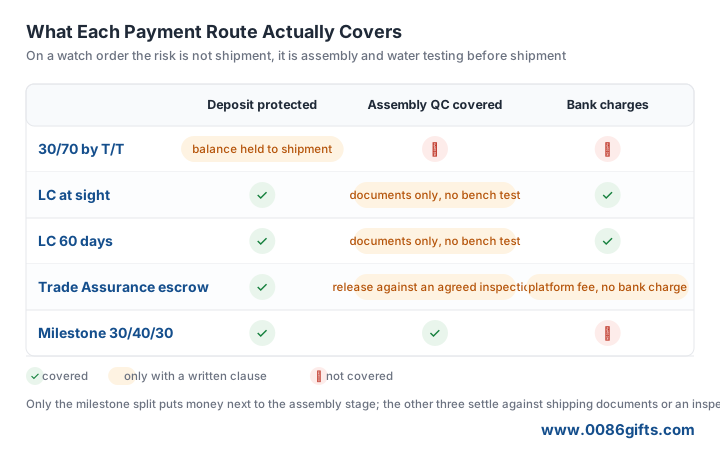
The milestone option is the one buyers underestimate. A 30/40/30 split pays the middle tranche after plating approval and before movement fitting, which is exactly where a watch order can still be corrected cheaply. It costs nothing but a second wire and a second inspection, and it turns the supplier relationship from a single bet into two checkpoints.

Send the quantity, the movement grade and whether this is a first order with the factory. We will quote the women watch range with both a 30/70 and a milestone schedule, and state which inspection each payment is released against, so the terms match the build instead of the category average.
Sourcing promotional gifts?
Send your item list and quantity for a quote and a digital proof.
Get a free quote


