Chinese New Year Production Cutoff: A 12-Week Gift Timeline
Every January, a batch of promotional gift orders misses its date for the same reason: the buyer counted backwards from the delivery date and not from the day the factory stops. Chinese New Year moves each year, the shutdown around it runs longer than the public holiday, and capacity tightens in the weeks before it as every other buyer tries to ship first. The workable method is to fix the shutdown date first, then reverse-schedule twelve weeks from it and treat each week as a gate that either closes on time or takes the order down with it.
Start from the day the doors close, not the delivery date
The public holiday is a fixed number of days, but the effective stoppage is longer at both ends. Workers from other provinces start leaving one to two weeks before the holiday to secure a train ticket, so output on the lines declines before the official closure. After the holiday, return dates stagger, and a factory that appears open in the first week of the new year may be running at half its usual headcount. Plan on a working stoppage of three to four weeks.
Everything in the promotional gifts range runs through the same gates, so one countdown works across a mixed order. That single assumption changes the arithmetic. A 12-week countdown from a three-week stoppage leaves about nine working weeks for artwork, tooling, production, inspection and freight. Most gift programmes that fail are not late by nine weeks; they are late by ten days at the artwork stage and then lose three weeks of capacity because the booking slipped past the point where the factory could still promise a pre-holiday ship date.
Weeks 12 to 9: artwork, tooling and approvals nobody else can give
This is the phase buyers control entirely, and the phase where most slippage is generated. Week 12 is the brief and the artwork file in a form the factory can work from: vector logo, Pantone references, and the exact placement and size on the item. Week 11 is the physical or digital proof, and week 10 is where tooling happens if the item needs it, a mould for a custom-shaped item, a steel rule die for a printed box, or a screen set for a multicolour print.
Week 9 is sample approval, and it needs a decision rather than a comment. A buyer who asks for a second round at week 8 has effectively removed the buffer, because the second round consumes a week of production capacity that the factory had already reserved. Decide at the first sample: approve, approve with a written correction list that does not change tooling, or restart. The middle option is the one that keeps a timeline alive.
Weeks 8 to 6: the production slot and the capacity squeeze
By week 8 the factory is allocating line time, and this is where the pre-holiday crunch shows up. Orders that arrived early get scheduled first, and an order that confirms late gets pushed into whatever gap remains, which is often a shorter run than the buyer wanted or a split production across two lines. Ask for the scheduled production date in writing, and ask what happens to it if the deposit lands a week late.
Material is the second constraint. Electronic gifts depend on components that are ordered in, and a housing or PCB that arrives late at the factory stalls the whole run regardless of line availability. Printed packaging has the same shape of risk: a box that is printed in a separate plant has its own queue, and it can arrive after the goods are finished, which leaves the order complete but unpackable.

Weeks 5 to 3: inspection, carton marks and the freight booking
Week 5 is inline inspection, done while the run is still on the line so a defect can be corrected inside the same production window rather than after it. Week 4 is final inspection and carton marking, and carton marks matter more than they look: shipping marks, side marks and the label artwork all need approval before the cartons are sealed, and a carton approval that arrives at week 3 means reopening boxes.
Week 3 is the freight booking, and it is the gate most likely to break a plan that was otherwise on time. Pre-holiday space fills early, trucking capacity to the port tightens in the same weeks, and a booking made late in the window gets a sailing after the holiday. Book with the production date in hand rather than waiting for the goods to be packed, and keep a second forwarder quote alive until the container is loaded.
Weeks 2 to 1: what still moves and what does not
In the last two weeks, production can still move if the run is short and the materials are already in the building. Almost nothing else can. A new print screen cannot be made and proved, a new mould cannot be cut, and a fresh carton print run cannot be squeezed in. Anything that requires an approval from the buyer in this window is effectively an instruction to ship after the holiday.
If the order is genuinely late, the useful move is to split it. Ship the portion that is finished and packed on the last available sailing, and let the balance follow in the first post-holiday week. A split shipment costs a second set of documents and freight, and it usually costs less than a complete miss on a dated event like a new year campaign.
A timeline that survives a late artwork change
Build the buffer into the front of the schedule, not the end. If the artwork is approved a week early, the tooling week absorbs the change; if the buffer sits before the freight booking, a late carton approval eats it and the sailing is lost. Put the slack at weeks 9 to 7, where a re-proof or a second sample can still be absorbed without touching the production slot.
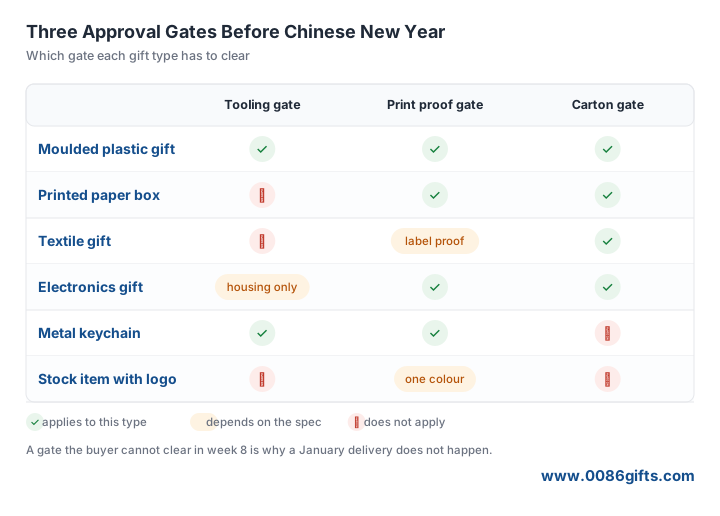
Write the schedule as a table with a date, an owner and a gate for each row, and send it to the factory with the purchase order. A timeline that exists only in an email thread is not a plan; it is a record of what everyone believed in November.
Sourcing promotional gifts?
Send your item list and quantity for a quote and a digital proof.
Get a free quote


