Corporate Gift Box Assembly: The Cost of Kitting 1,000 Units
Kitting is a production step, not a packing step. When a supplier quotes a corporate gift box at 1,000 units, the number is built from four separate costs: the components themselves, the insert that holds them, the minutes of assembly per box, and the carton the finished boxes ship in. Most quotes fold all four into one figure, which is why two suppliers can differ by 30 percent on what looks like the same box and both be telling the truth.
Assembly is charged per box, in minutes
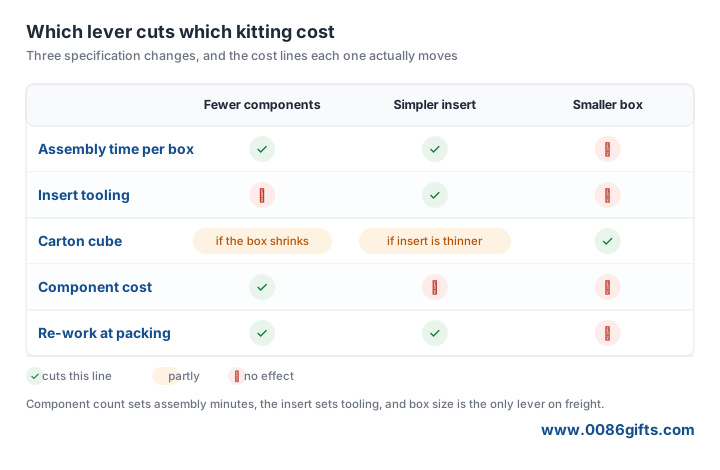
Someone opens the box, places the components, folds the tissue, closes the lid and applies a seal or a sleeve. That sequence takes time, and the time scales with the number of components rather than with the value of the gift. A two-piece box with tissue is a different job from a five-piece box with a ribbon and a card, and the difference is not proportionally small: the fifth component adds handling, positioning and a second quality check.
Ask for assembly time per box in seconds, then multiply. At 1,000 units, a difference of twenty seconds per box is a real line in the quote, and it is the line most often left unstated. If the supplier cannot give a seconds-per-box figure, ask how many boxes one person assembles in an hour on this specification, which is the same information in a form they can answer.
The insert is where the cost hides
An insert does two things: it holds each component in place so the box can be handled and shipped, and it sets how long assembly takes. A die-cut EVA foam insert with cavities is quick to load but needs a cutting die and carries a per-unit foam cost. A folded cardboard platform is cheaper per unit and slower to assemble. A moulded pulp tray sits between the two and is only economical when the tray shape matches an existing tool.

The practical rule for a 1,000-unit run is to design the insert around the components you have already chosen, not the other way round. If the insert requires a new cutting die, that die is charged once, but if the cavity layout forces a larger box, the die cost is the smaller problem: the box size follows the insert, and the box size sets freight.
Component count drives both purchase and handling
Every component adds three costs at once: its own purchase price, its handling time, and its inspection. That is why removing one item from a gift box rarely reduces the total by the item's price alone. A five-piece box reduced to four usually saves the component cost plus the handling time plus one inspection point, and the saving is largest on the cheapest, fiddliest item, not the most expensive one.
When a budget has to come down, look at the small items first: the card, the ribbon, the sticker, the second pouch. They carry the worst ratio of handling time to purchase price, and their removal is invisible in the unboxing photograph if the layout is re-set.
Carton cube and double cartoning
A finished gift box is mostly air. It cubes out long before it weighs out, so the freight cost per unit is set by the outer carton dimensions rather than by the total weight. Ask for the master carton dimensions and the number of gift boxes per carton, and calculate the cube per unit yourself. Two suppliers at the same unit price with cartons of different sizes are not at the same landed cost.
Double cartoning, where the gift boxes travel inside an inner carton that itself goes inside a master carton, protects corners and keeps the retail box clean, and it costs cube. For a gift box with a printed lid and a foil logo, that protection is usually worth it; for a plain kraft box, it usually is not. Decide this against the damage you would have to absorb, not against the carton price.
How to ask for a kitting quote
Request the quote in five lines and insist they are separated: components with quantity per box, insert type with its tooling charge, assembly in seconds per box, gift box and outer carton with dimensions, and the packing method including any inner carton. Add the artwork items, because a printed sleeve, a foil stamp on the lid and a printed card each carry their own setup and are routinely quoted as one lump.
With those five lines, a 1,000-unit comparison becomes simple arithmetic instead of a negotiation. You can see whether the cheaper quote saved on the insert, on assembly time, or on the carton, and you can decide whether that saving is one you want. The same five lines also tell you what happens at 500 units, because the tooling lines stay fixed while the assembly and component lines halve.
Sourcing promotional gifts?
Send your item list and quantity for a quote and a digital proof.
Get a free quote


