Women Watch Water Resistance: 3 ATM vs 5 ATM vs 10 ATM
The number on a watch dial is a test rating, not a depth you can swim to. A 3 ATM women watch is rated to withstand the static pressure found at 30 metres, and it will still fog up in a swimming pool, because a moving wrist in water applies pressure in spikes that no static test reproduces. The three ratings sold in gift and promotional ranges behave differently in daily use, and the difference matters most to the buyer who has to answer a customer complaint six months after the order ships.
What the ATM Number Actually Measures
ATM stands for atmospheres, and the rating is tested under ISO 22810, the standard for water-resistant watches. The test applies static pressure to a complete watch, usually by air first and then by water immersion, and checks for leakage into the case. One atmosphere of pressure is equivalent to roughly 10 metres of water depth, which is why 3 ATM is often written as 30 m. That equivalence is a laboratory figure. It says nothing about the pressure created by diving into a pool, hitting the surface at speed, or pressing a button underwater.
There is a second reason the rating is misunderstood. A watch that passes at 3 ATM on the day it leaves the factory depends on four seals: the case back gasket, the crown stem, the crystal seating and the pushers if there are any. A crown left pulled out, a gasket dried out by hot water, or a case back that was opened for a battery change all defeat the rating without changing what the dial says.
3 ATM: Splash Resistance, and What Defeats It
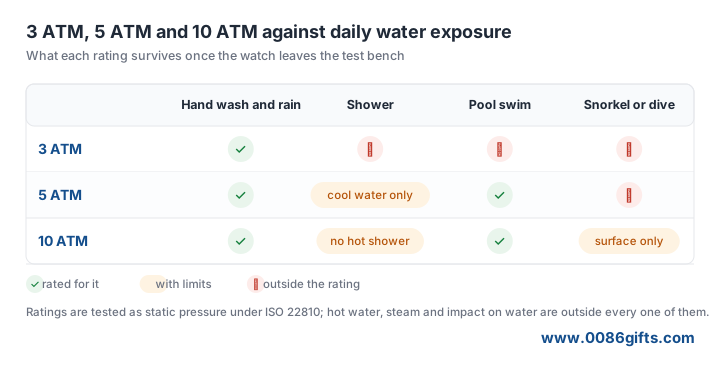
3 ATM covers rain, hand washing and an accidental knock against a wet counter. It does not cover swimming, showering, dishwashing or leaving the watch on a bathroom shelf where steam collects. The failure mode is slow: warm water and soap soften the gaskets, steam penetrates the case as vapour and condenses inside the crystal, and the first sign is a foggy patch that clears after a day. By then the movement has already seen moisture.
For a promotional or gift order, this is the practical consequence: if the watch will be worn by someone who swims, 3 ATM is the wrong specification, and no amount of packaging copy will fix it after the fact.
5 ATM: The Realistic Daily Grade
5 ATM handles hand washing, rain, kitchen work and short swims in a pool. It is the rating that most gift and retail watch ranges should carry if the buyer wants a product that survives normal use without a care warning on every page. The limits are still real: hot showers, saunas and hot tubs are out, because heat expands the seals faster than the case can compensate, and so is any activity where the watch is pressed against the body while submerged.
In practice, 5 ATM is where the cost step happens. Reaching it needs a tighter case back seal and a better crown gasket, which is the difference between a friction-fit back and a screw-down back on many constructions. That single change is usually visible on the sample, so ask for a photo of the opened case back before approving.
10 ATM: Pool Swimming, Not Diving
10 ATM covers swimming and snorkelling at the surface, and it is the highest rating worth paying for on a fashion watch. It does not make a watch a diving instrument: diver watches are certified separately under ISO 6425, which adds requirements such as legibility in darkness, a unidirectional bezel and a resistance test beyond what ISO 22810 covers. A 10 ATM watch with a decorated dial is a swim watch, and describing it otherwise invites a return.

How the Rating Is Tested, and How to Check a Sample
Production testing is usually an air-tightness check per piece rather than a full water immersion, because air testing is fast, dry and does not leave residue. That means a watch can pass the factory test and still leak in service if a gasket is pinched or the case back is not seated squarely. Three checks on a sample catch most of it.
- Ask for the test method, not just the rating. Air pressure test, water immersion, or both. A supplier who can name the method and the pass criterion is a supplier who tests.
- Look at the seals. Crown gasket present and seated, case back gasket uniform with no twist, crystal flush with the case. A gap at the crystal edge is a leak path.
- Run a condensation check. Warm the watch gently, place a cool drop of water on the crystal, and look for fogging on the inside. It is a crude test, but it is the same symptom the end user will report.
What to Write in the Order
Four lines decide whether the rating survives to the customer. State the rating as 3 ATM, 5 ATM or 10 ATM, and require it to be marked on the case back rather than printed only on the box. Name the test method and whether it is per piece or by batch sample. Specify the crown type and the case back construction, since both are what the rating depends on. And require a care card in the packaging that names the limits: no hot water, no sauna, no pressing buttons underwater, and a battery change reseals the case.
The marketing wording matters as much as the engineering. Under ISO 22810 a watch is water resistant, not waterproof, and the distinction is the one that ends up in a complaint. Keep the claim to the rating and the conditions it covers, and the product does what the page says.
Tell us the rating you need, the case back construction and the quantity, and we will quote the three grades side by side with the test method for each, plus a sample you can put through the checks above. Start from the women watch range to pick the case style before the rating is fixed.
Sourcing promotional gifts?
Send your item list and quantity for a quote and a digital proof.
Get a free quote


