Promotional Pen Writing Test: 6 Checks on a Sample
A promotional pen is approved on a sample that writes twenty words and shipped in a run of 5,000 that sits in a warehouse for four months before anyone writes with it. The six checks below are aimed at that gap: they test the pen after it has been stored, carried upside down and dropped, not straight out of the box. Each takes under an hour and needs nothing more than a sheet of paper, a scale and a fridge.
A sample is usually the best pen in the batch — the one the technician picked up and tested before packing. A bulk run is not. Between them sit three variables the sample never shows: how long the ink has been in the refill, how the cartons were stored, and whether the printing on the barrel was cured at the same temperature as the sample.
So test the sample the way the end user will meet it. Leave it uncapped for half an hour, put it in a warm place upside down overnight, then write. A pen that survives that is a pen whose refill and feed are actually matched to the barrel.
Check 1: First Stroke after Standing
Take the cap off, leave the pen tip up for 30 minutes, then write the first line without scribbling. A hard start — a dry scratch before ink appears — means the ball seat is not holding the ink column, and it will get worse in a warehouse, not better. Repeat with the pen stored tip down for the same 30 minutes; a pen that only starts reliably in one orientation will fail half of its users.
Write the result down as the number of dry strokes before the first solid character rather than "starts fine". Zero is the pass; three or more at 30 minutes predicts complaints at 30 days.
Check 2: Line Consistency across a Full Page
Write a complete A4 page of continuous text in one go, without pausing, and look at the last third of the page against the first. Ink starvation shows as a line that thins and lightens as the page fills — the feed cannot keep up with consumption. Then write a single continuous line around the page edge five times without lifting the tip, which is harder on the feed than normal writing.
This is also where a cheap tip shows. A ball that is slightly out of round leaves a line with a scalloped edge, visible at a glance under a lamp. It still writes, but at 5,000 units it is the difference between a pen that feels smooth and a pen that feels gritty.
Check 3: Leak and Blobbing under Heat
Put the pen, capped and tip down, in a warm place at about 40°C for 24 hours — a closed car in summer, or an oven on its lowest setting with the door ajar. Then open it and look inside the cap. Ink pooling in the cap, or a blob at the tip on first write, means the ink viscosity is too low for the climate the pens are shipping to.

Repeat the test tipped up. A pen that leaks in one orientation only tells you the ink is marginal, and the fix is at the ink batch, not at the assembly line — so this result belongs in the written spec before the order is placed.
Check 4: Write-Out Measured by Weight
Nobody can judge ink volume by writing a few lines, and "long lasting" on a spec sheet is not a number. Weigh the refill on a pocket scale, write a measured distance — 100 m on a treadmill of paper, or a fixed number of A4 pages if that is easier — then weigh it again. Mass lost per metre is the consumption rate; divide the refill's ink mass by that rate and you have the write-out in metres.
Do the same for the competitor pen you are being compared against, on the same day, with the same paper. This single number usually settles the argument about whether a refill upgrade is worth the cost per unit, because it converts ink into metres that a buyer can hold next to the price.
Check 5: Clip Retention
Clip a pen to a folded piece of shirting or a notebook cover, hang a 200 g weight from the barrel, and leave it for a minute. The clip should hold without opening. Then open and close the clip twenty times — that is roughly a month of pocket use — and repeat the weight test.
Most clip failures are not the clip but the attachment: a clip riveted into thin ABS cracks at the rivet, while the same clip moulded as one piece with the cap survives. Ask which construction you are buying, because it does not show in a photograph.
Check 6: Print Wear on the Barrel
Rub the printed logo with a soft eraser fifty times, then wipe a separate pen with an alcohol swab once. Pad printing that has been properly flamed or primed survives both; print that was cured at the wrong temperature comes off as a grey smear on the eraser and a pale patch where the logo was.
This matters more than it looks, because the logo is the whole reason the pen exists. A pen whose branding disappears in a bag is a pen that delivers no impressions, and the buyer finds out three months after delivery.
The matrix below shows which check reaches which failure — they are not interchangeable, and a pass in one column tells you nothing about the next.
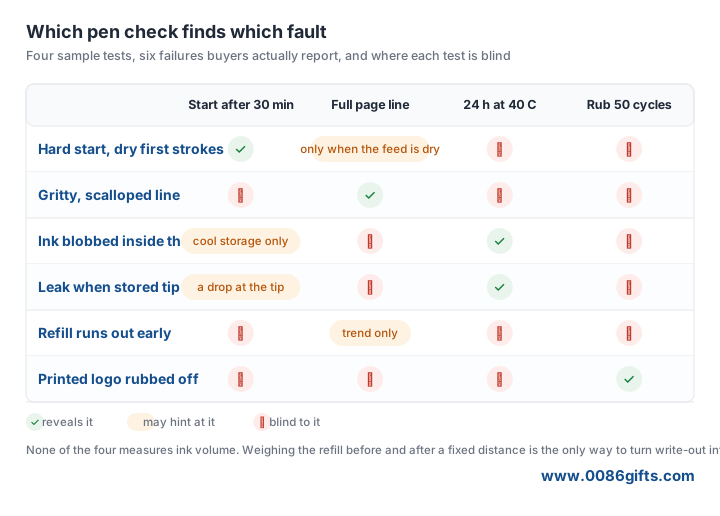
Run all four columns on three pens from the bulk carton, not on the sample, and put the results in the purchase order next to the refill type. When you order plastic promotional pens, ask for the ink batch number and the write-out figure in metres — those two facts explain most of the difference between two quotes that look identical on paper.
Sourcing promotional gifts?
Send your item list and quantity for a quote and a digital proof.
Get a free quote


