Women Watch Case Plating: 4 Wear Tests Before Bulk
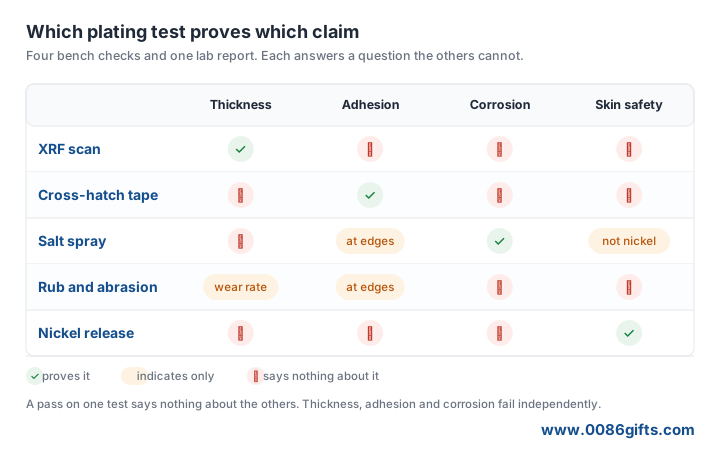
A plated watch case fails in a predictable order: the colour dulls, then the edges go pale, then a green ring appears on the wrist. Each of those is a different failure with a different test, and a supplier who only shows you a gold-coloured photo has tested none of them. Four bench checks and one lab report cover the claims that matter on a women watch order, and each one answers a question the others cannot.
What sits under the gold
Most fashion watch cases are brass or zinc alloy, plated in layers: a copper or nickel strike for levelling, then the colour layer, then sometimes a clear topcoat. Stainless steel cases are usually brushed or PVD coated instead, which behaves differently. The colour layer is either electroplated gold in a designated tone or a PVD film, and the tone is normally written with the N designation: 1N is pale yellow, 2N yellow, 3N rose, with 4N and 5N moving further into pink and red. Two factories quoting the same rose gold can be quoting 3N and 4N, which look alike in a photo and different on a wrist.

Plating thickness is the number that decides everything downstream. Thin gold over a polished brass case looks correct in the box and goes pale within months of daily wear, because the film is being abraded a few microns at a time. Ask for the thickness in microns on the specification, not a word like heavy or thick, and ask whether the figure applies to the flat of the case or the average including edges.
Test one: thickness by XRF
X-ray fluorescence gives a non-destructive thickness reading in microns, and a bench instrument produces it in seconds. It is the cheapest useful test here and the one to request first: a thickness number predicts the other results. Ask for readings at several points on one case: the flat of the back, the bezel, a lug, and an edge. Edges plate differently from flats, and a report that only quotes one point is a report that has chosen the easiest point.
Read the result against the method. Electroplated gold is usually quoted somewhere between a couple of microns and ten, and the number has to be read together with hardness and topcoat, because a soft thick film can wear faster than a hard thin one. PVD films are typically thinner and harder, which is why they hold colour longer on a bezel that rubs against a sleeve all day.
Test two: adhesion by cross-hatch
Adhesion failures look like flakes lifting at an edge or a patch of colour coming away around a lug. The standard check is the cross-cut test in ISO 2409: a lattice of cuts through the coating, a specified tape applied and pulled, and the result classified from zero, meaning nothing came away, to five, meaning most of the lattice lifted. A supplier who can show a class zero or one result on the actual case has demonstrated something a photograph cannot.
Do the test on a plated sample rather than a flat test coupon. A coupon proves the plating bath works on a flat brass plate; a case has curved surfaces, edges, drilled lugs and a bezel seat, and those are where adhesion actually fails.
Test three: corrosion and skin contact
Corrosion shows up as pitting, blisters or a greenish stain, and on a watch the visible symptom is often on the customer rather than on the product. Two routes exist. A salt spray exposure in the ISO 9227 neutral salt spray regime is the common factory-side screening test, and hours to first visible corrosion is the number to compare between samples. For gold alloy coverings specifically, ISO 3160 sets out requirements for thickness, corrosion resistance and adhesion on watch cases and accessories, and a factory that already works to it will recognise the reference immediately.
Skin contact is a separate question. Nickel release is regulated in the EU under REACH, with a limit of 0.5 micrograms per square centimetre per week for articles in prolonged contact with the skin, tested to EN 1811 after simulated wear and corrosion to EN 12472. A plated brass case usually carries a nickel strike under the colour layer, so the risk is real wherever the gold wears through, especially on a case back. Ask for the nickel release report if the order is going into the EU, and check that the test was run after wear simulation rather than on a fresh sample.
Test four: wear and colour transfer
The rub test is the one buyers can run themselves in ten minutes. Take a white cotton cloth, add a little alcohol, and rub the case back and a lug for a fixed number of strokes with firm pressure. Colour on the cloth means the topcoat or the colour layer is transferring, and that is a finish that will mark a sleeve. Repeat the same rub on a control sample of a finish you already sell, because absolute judgements about a cloth are unreliable and a side-by-side comparison is not.
For a quantified number, ask for an abrasion test on a Taber instrument with the wheel type and load stated. The value of that test is comparability: two suppliers running the same wheel and load produce numbers you can put next to each other. Numbers from different setups cannot be compared, which is why the wheel and load have to be written down with the result.
What to put in the sample request
One page is enough. Base metal and whether the case back is the same material as the case. Colour tone in the N designation, plus a physical reference if you have one. Plating method and thickness in microns, with the measurement points named. Topcoat, if any, and its chemistry. Then the four results: XRF reading at the named points, cross-hatch class to ISO 2409, salt spray hours to first corrosion, and the rub test result against your control sample. Add the nickel release report when the destination market requires it.
A factory that answers all of that on the first sample is telling you something about how the bulk run will be handled. A factory that answers two of the four and sends a photo of the rest is telling you the same thing, earlier and more cheaply than the bulk order would have.
Send the colour tone, the destination market and the wear you expect the watch to survive, and we will confirm which plating method and which test reports the case will ship with.
Sourcing promotional gifts?
Send your item list and quantity for a quote and a digital proof.
Get a free quote


