Power Bank Capacity Claims: The 20-Minute Discharge Test
A 10,000 mAh power bank does not deliver 10,000 mAh to a phone, and that is not a trick — it is arithmetic. The cells are rated at 3.7 V, the port outputs 5 V, and the boost conversion loses something in between. A buyer who knows the conversion can tell an honest label from an inflated one in twenty minutes, with a USB load tester and a stopwatch, without discharging anything.
The method below works on any portable power bank between 2,000 and 20,000 mAh. What follows is the arithmetic first, then the twenty-minute test that catches the cases where the arithmetic still does not add up, then the lines to put in the purchase order so the next shipment can be checked the same way.
Do the watt-hour arithmetic before you plug anything in
Capacity in mAh is a current figure, and current only means something next to a voltage. Convert to watt-hours: 10,000 mAh at 3.7 V is 37 Wh. Deliver that through a 5 V output at 87 percent conversion efficiency and you get about 32 Wh at the port, which is roughly 6,400 mAh at 5 V. A phone that accepts 3,000 mAh per charge will see two full charges, not three.
So the first question to any supplier is not the mAh number, it is the Wh number and the conversion efficiency they claim. If a quote says 10,000 mAh and 37 Wh, the label is internally consistent. If it says 10,000 mAh and 50 Wh, one of the two numbers is decorative, because 10,000 mAh at 3.7 V cannot be 50 Wh.
This is also the fastest way to spot a relabelled cell. A 5,000 mAh cell relabelled as 10,000 keeps its 18.5 Wh, so the weight gives it away before any test: a genuine 10,000 mAh bank in an aluminium shell usually lands between 200 and 230 g, and a relabelled 5,000 mAh unit comes in nearer 130 to 160 g. Weigh five units from a carton and compare.
The 20-minute test: 2 A load, one voltage reading a minute
Put the bank on a USB load tester set to a constant 2 A at 5 V, start a timer, and write down the voltage every minute for twenty minutes. Twenty minutes at 2 A is 667 mAh, about a tenth of a 10,000 mAh bank, which is enough to characterise the cell without flattening it.
Two numbers come out of that window. The first is the delivered capacity in that period — 2 A times one third of an hour, which should read close to 667 mAh on the tester's counter. The second, and the more useful one, is the voltage at minute twenty. A healthy cell with an adequate boost circuit holds 4.75 V or better at 2 A. A unit that sags to 4.6 V or below under the same load has either a high-resistance cell or a boost circuit sized for a smaller current than the label claims, and it will charge a phone slowly and run hot.

Temperature belongs in the same window. Feel the housing at minute twenty: warm is normal, hot enough that you would not hold it is not, and a bank that reaches that point at 2 A will do worse at the 2.4 A some phones pull. Note the reading rather than the impression, since "warm" means different things to different hands.
Test both ports, and test them together
A two-output bank is two circuits sharing one cell, and the second port is where labels get optimistic. Run the same 2 A test on each port separately, then run both at once with a 1 A load on each. A bank rated for 2.1 A total that sags to 4.5 V with two devices attached is really a 1 A plus 1 A design wearing a bigger number.
The cable matters here, and it is the cheapest thing to standardise. Use one known-good 20 AWG cable for every test, marked and kept with the tester. A thin charge-only cable will add 0.2 to 0.4 V of drop at 2 A and make an honest bank look like a bad one — which is exactly how a supplier wins an argument you should have won.
What the label is allowed to say, and what it is not
Rated capacity at cell voltage is the normal way to state a power bank, so a 10,000 mAh label is not a lie by itself. What is not acceptable is a label that states 10,000 mAh, ships 5,000 mAh of cells, and relies on the buyer never doing the watt-hour sum. The honest disclosure pattern is to print both: cell capacity in mAh and watt-hours, plus the rated output current.
Ask for the cell datasheet, not a certificate photograph. The datasheet gives nominal voltage, capacity tolerance and maximum continuous discharge, and those three numbers tell you whether the cell can support the port current the label promises. A cell rated for 1 C continuous on a 5,000 mAh unit is a 5 A cell, which is fine; the same cell at 0.5 C is 2.5 A, which explains a sag under a 2.4 A phone.
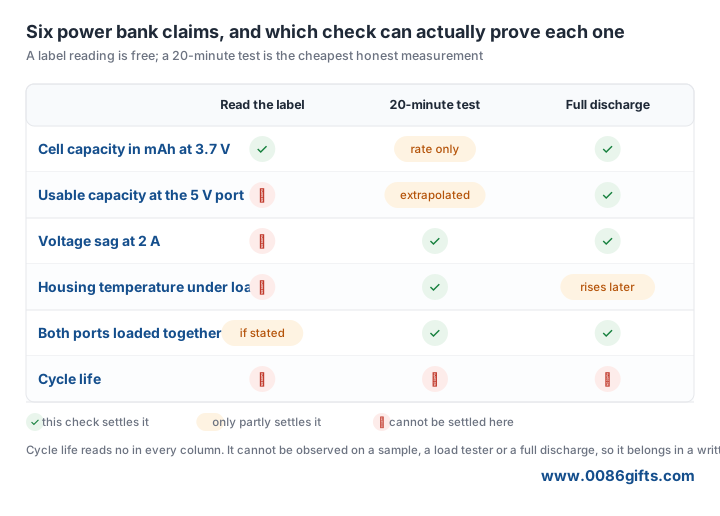
Write the test into the order, with sampling and pass lines
The lines that survive a change of factory: 2 A constant load for twenty minutes on one unit per carton, voltage at minute twenty no lower than 4.75 V, delivered capacity within 10 percent of 667 mAh, housing not too hot to hold, and both ports tested separately and together. Five lines, all of them repeatable with a tester that costs less than one returned pallet.
Then put the watt-hour arithmetic on the purchase order next to the mAh figure, so the two have to agree before the first carton is built. A supplier who can answer the Wh question has done the sum themselves; one who cannot has been copying a number between quotes, and that is the shipment most likely to arrive with a label that does not survive a weigh-in.
Sourcing promotional gifts?
Send your item list and quantity for a quote and a digital proof.
Get a free quote


