Wall Clock Movement Grades: Sweep vs Step at 500 Units
Wall clock buyers choose between sweep and step for reasons that have little to do with the clock on the wall. The choice changes the gear train, the current draw, the sound in a quiet room and the failure mode a year later. At 500 units the difference is not a line on the quote; it is which complaint you are going to handle.
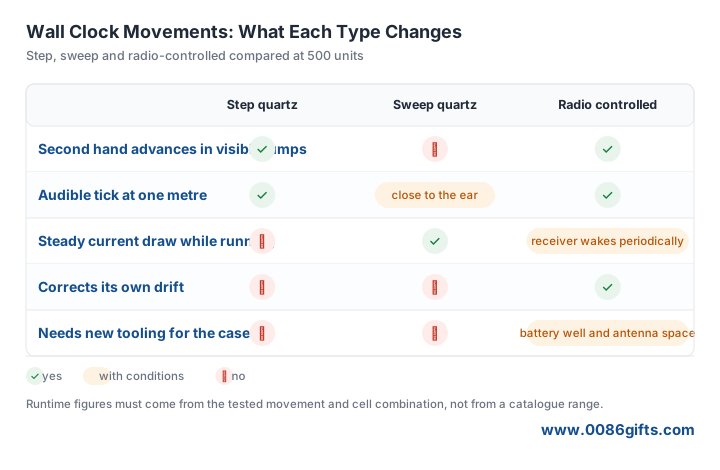
Both movements run from the same principle. A quartz crystal oscillates at 32,768 Hz and a divider circuit turns that into a once-per-second pulse. What happens next is the whole difference: a step movement releases the pulse into the gear train as one jump, so the second hand lands on a mark and stops. A sweep movement drives the hand through many small increments, so it appears to glide, and that appearance costs a different gear train and a higher current draw.
What the Two Movements Differ In
The step movement is the older and simpler design. One pulse, one tooth of advance, and the hand rests between pulses. Because the hand is at rest most of the time, the movement draws current in short bursts, which is why the same cell runs longer in a step clock than in a sweep clock of the same size.
A sweep movement advances the hand in a series of small steps that the eye reads as continuous. It needs a finer gear train and a controller that keeps the hand moving, so it costs more to build and drains the cell faster. The trade is silence and a smoother read: in a room where people work, a step clock at one tick per second is audible, and a sweep clock is not.
Accuracy: What the Datasheet Tells You and What It Hides
Quartz accuracy is quoted either per day or per month, and the two figures are not interchangeable even when they look similar. Ask which unit the number uses and whether it was measured at room temperature or across the operating range. A movement rated over a narrow band will drift more in an unheated corridor or a warehouse office.
Accuracy also has a mechanical component that no datasheet covers: hand alignment. A movement can keep perfect time while the hour and minute hands sit a degree off their reference, which reads as a defect to anyone standing in front of the clock. Check hand alignment at 12:00 on the sample and again at 6:00, because a badly pressed hand can drift on the arbor rather than sit wrong from the start.
Noise Is a Site Decision, Not a Component Decision
A tick that is charming in a kitchen is a complaint in a meeting room, a clinic waiting area or a hotel corridor. Before choosing, decide where the clocks will hang and how close a person will be to the face. A step movement at arm length in a quiet room is audible; at three metres behind a reception desk it usually is not.
If the answer is a quiet space, a sweep movement solves the sound and adds a battery question. Do not accept a runtime figure quoted from a different movement size. Ask for the tested runtime of the exact movement and cell combination you are buying, and treat any answer that changes when you ask twice as a number to re-test.

Radio Control: The Third Option Buyers Forget
A radio-controlled movement takes its time from a broadcast signal and corrects itself, so drift disappears as long as reception exists. That is a real advantage for a clock that will hang in a public building for years, and a real problem where the signal does not reach: steel-frame buildings, basements and some regions outside the transmitter footprint. A clock that fails to sync does not stop; it runs as an ordinary quartz movement with ordinary drift, and the user assumes the clock is broken.
If you choose radio control, state the coverage assumption on the order and ask what the movement does when it cannot sync. A movement that retries quietly is different from one that displays a fault code in front of customers.
Four Checks on a 500 Unit Sample
Listen at one metre. Stand a step and a sweep sample side by side in the same room and listen at the distance the clock will hang. This settles the noise argument faster than any specification.
Watch the hand at the mark. A step hand should land cleanly on the mark and stay there. A hand that overshoots and settles back has a gear train that will wear.
Check hand alignment twice. At 12:00 and at 6:00, with the clock flat and then hanging. A hand that shifts between the two positions was pressed onto the arbor badly.
Open the battery compartment. Look at the contact material and the spring tension. Most returns on a promotional clock are a battery contact, not a movement.
What to Write on the Order
Movement type with the model number; accuracy figure with its unit and test condition; tested runtime for the exact movement and cell; noise expectation for the installation site; hand alignment tolerance; battery type and compartment access; and the radio control coverage assumption if applicable. Add the movement supplier name, because a substituted movement mid-order changes every one of those numbers.
Send the wall space, the quantity and whether the clocks go into quiet rooms. We will quote a step and a sweep movement against the same case and dial so the difference is visible per unit, and ship both movements in a sample for a listening test. See the full wall clock range for cases that suit each movement.
Sourcing promotional gifts?
Send your item list and quantity for a quote and a digital proof.
Get a free quote


