Hard Cover Notebook GSM and Binding: 5 Specs That Decide Price
Two hardcover notebooks can quote 30 percent apart and look identical under a phone camera. The gap is almost never the cover print. It sits in five places: the text paper, the page count as it rounds to signatures, the binding method, the grey board in the case, and how the cover is decorated. Change any one and the price moves; change all five at once and you are no longer comparing two quotes for the same object.
This is the order to fix them in for a hard cover notebook programme, whichever end of the market you are buying for. Fix the paper last and every earlier decision gets re-priced.
Paper: grams per square metre, and the bulk behind it
Text paper is quoted in gsm, and the number buyers underestimate is bulk, the thickness of a given weight. An 80 gsm woodfree and an 80 gsm cream book paper can differ in calliper, so the same 160-sheet block comes out visibly thicker on one than the other. If the notebook has to feel substantial in the hand, bulk buys that feel more cheaply than gsm does.
Three grades cover most programmes. Uncoated woodfree at 70 to 80 gsm is the workhorse: it takes ballpoint and pencil without feathering, and it is the cheapest per tonne that still feels like paper rather than newsprint. Cream or ivory uncoated at 80 to 90 gsm is the gift and stationery grade, easier on the eye for long writing and warmer under a foil-stamped cover. Coated at 100 gsm and above is for notebooks that carry colour printing inside, and it writes badly with a pencil because the surface is sealed.
Page count is a signature problem, not a number you choose
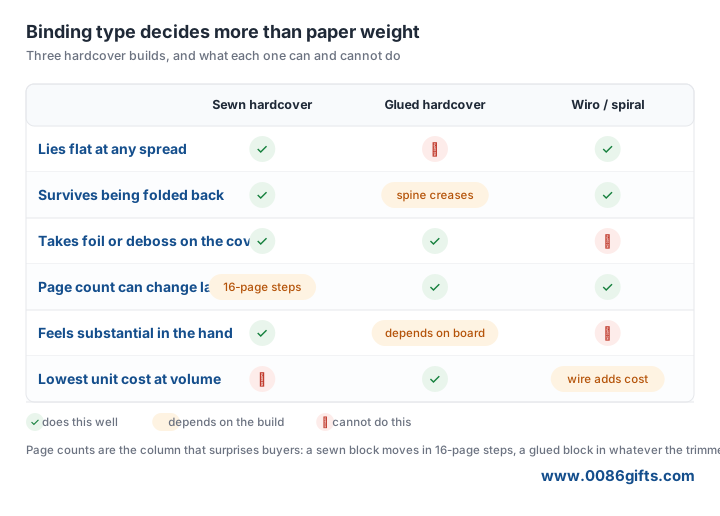
A 16-page signature is the standard unit of a sewn book block. That means the block grows in steps of 16 pages, or 8 sheets, and a request for 150 pages becomes 160 unless the printer is willing to hand-insert a smaller signature at extra cost. Specify the page count as a multiple of 16 and you remove one negotiation from the order.
The second trap is sheets versus pages. A buyer asking for "200 pages" and a factory quoting "100 sheets" are describing the same book, and a buyer asking for 200 sheets is asking for 400 pages. Write both numbers on the spec sheet and the mistake cannot survive the first email.
Binding: sewn, glued, or wiro
Sewn binding stitches each signature through the fold and glues the spine into the case. It lies flat, it survives being folded back on itself, and it opens at any spread without the block pulling away from the spine. It also costs more per unit in labour, and it is the reason two otherwise identical notebooks differ in price.

Perfect binding glues the trimmed block edge into the cover. It is cheaper, it handles page counts that do not fit signature maths, and it does not lie flat; open it wide and the spine creases. For a promotional notebook that will be written in at a desk, that is usually acceptable. For a journal sold as a keepsake, it is the detail a customer notices in the first minute.
Wiro and spiral sit outside the case-bound family entirely. They lie flat, they open 360 degrees, and they take a hard back board instead of a wrapped case, so they skip the case-making cost but add the wire. They also cannot carry foil or deboss on a wrap, because there is no wrap.
The case: grey board thickness and the wrap
The case is two boards, a spine strip and a wrap. Board thickness is the field that decides whether the notebook feels like a gift: 1.5 mm reads as a stiff brochure cover, 2 mm is the retail default, and 2.5 mm gives the dense, slightly heavy feel that buyers associate with premium stationery. Going up one step adds little material cost and a noticeable amount of perceived quality, which makes it the cheapest upgrade in the whole specification.
The wrap matters as much. Paper wrap takes print and foil well and is the standard for promotional work; PU or textile wrap changes the hand feel and needs a different turn-in allowance, so the board size has to be re-cut. Ask for the turn-in width in millimetres, and ask whether a headband and a ribbon marker are included, because both are usually quoted as separate line items and both are visible on opening.
Cover decoration: foil, deboss, and what setup costs
Foil stamping uses a heated die and a foil carrier; the die is a one-off cost and the foil is consumed per impression, so a single small logo is cheap at 3,000 pieces and expensive at 300. Deboss uses a die with no foil, which is the cheapest way to add a tactile mark and the most forgiving on a textured wrap. Screen print on a case is the budget option for a flat colour logo, and it sits on the surface rather than in it.
The mistake to avoid is stacking three decoration methods on one cover to look premium. Each adds a die, a setup and a pass through the press, and the cumulative cost is far more than the visual difference. Pick one primary mark in foil or deboss, and let the board thickness do the heavy lifting.
What to put on the enquiry
Eight lines make a hardcover quote comparable: finished size, page count and sheet count, text paper gsm and shade, binding method, board thickness, wrap material, decoration method and area, and packing quantity per carton. Add the elastic band or ribbon if the design needs one, and state whether the cover artwork will be supplied as a die-cut template.
Then ask for the quote split by line: paper, printing, binding, case making, decoration. A supplier who will only quote a single unit price is telling you that the five levers above are not yours to move, and at that point the only remaining negotiation is on volume.
Sourcing promotional gifts?
Send your item list and quantity for a quote and a digital proof.
Get a free quote


